
What Size Jewelry for Daith Piercing
Getting your daith pierced is exciting. Getting the wrong jewelry size is a fast way to ruin that excitement with swelling, migration, or a piece that looks visually off. Before you sit down in the piercer’s chair, or swap out your starter jewelry for something new, you need to understand the sizing basics. This guide breaks it all down clearly.
Why Daith Sizing Is More Specific Than Other Piercings
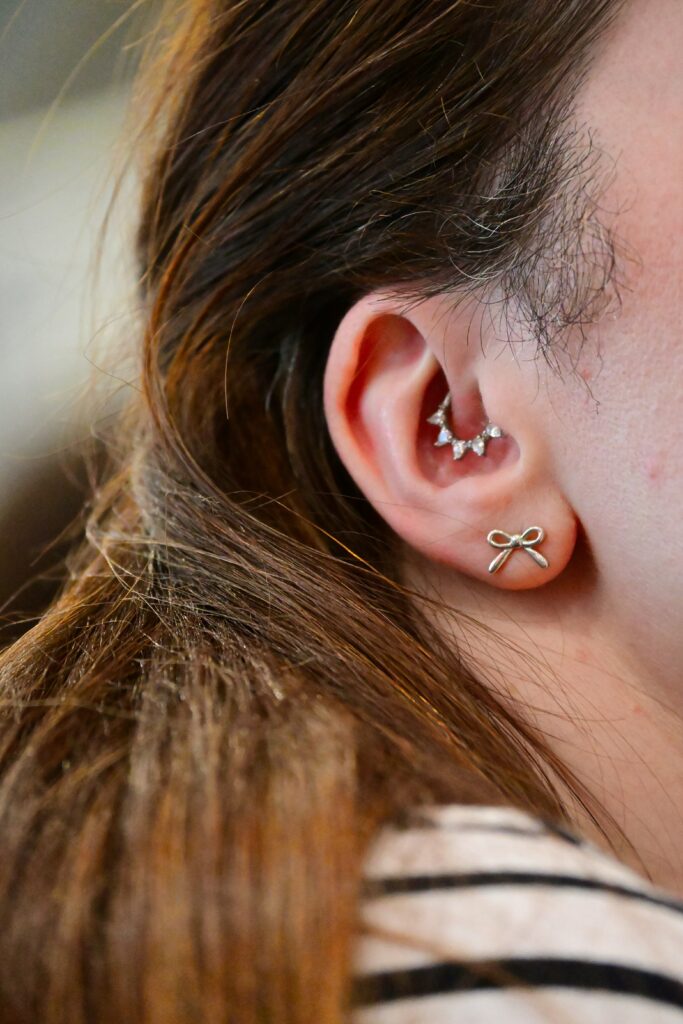
The daith sits in a tight anatomical fold of the inner ear cartilage, the crus of the helix. That location means there is a narrow margin for sizing error. Go too large on the diameter and the ring hangs awkwardly or puts pressure on surrounding cartilage. Go too small and the ring pinches, restricts airflow, and creates a hostile healing environment.
Most piercers treat daith sizing as a measured process, taking actual calipers to the ear before recommending jewelry. That is the right approach. Your ear anatomy is the primary variable, and two people with identical ears on paper can still need different ring sizes based on the exact depth of that fold.
The Standard Sizing Ranges
Gauge (Thickness of the Bar or Wire)
Gauge refers to the thickness of the jewelry post or wire. For daith piercings, the overwhelming standard is 16 gauge (1.2mm). Some piercers go with 14 gauge (1.6mm) for clients with thicker cartilage, but that is less common. Anything thinner than 16 gauge risks cheese-wiring through cartilage over time.
Stick with 16 gauge for a fresh piercing. Once fully healed, you have more flexibility, but starting heavy or light is a gamble.
Inner Diameter
Inner diameter is the measurement of the open space inside a ring. For daith piercings, the typical range runs from 8mm to 12mm, with 9.5mm and 10mm being the most common starting points.
Here is a quick reference for the standard options:
| Inner Diameter | Best For |
|---|---|
| 8mm | Very small, tight daith anatomy |
| 9.5mm | Average ear anatomy, most common choice |
| 10mm | Average to slightly larger anatomy |
| 11mm | Larger cartilage folds, some initial swelling accommodation |
| 12mm | Larger anatomy or significant initial swelling |
A fresh piercing almost always benefits from slightly more room than you think you need. Cartilage swells after being pierced, and a ring sized exactly to your resting anatomy can become tight within 24 hours of the procedure.
Jewelry Styles That Work for Daith Piercings
The most popular choice for a daith is a seamless ring or a clicker ring. Both work well. Curved barbells are another option, though they suit certain ear shapes better than others.
Here is what matters for each style:
- Seamless rings: Simple, clean, and easy for the piercer to fit precisely. The gap opens and closes by hand.
- Clicker rings (hinged segment rings): Easier to open and close independently, which matters during healing when you want to minimize contact with the jewelry.
- Captive bead rings: Functional but harder to insert without tools, making them a poor choice for a fresh daith.
- Curved barbells: Work for some anatomies, particularly if the daith fold is shallow. The ends need to be sized to clear both sides of the fold comfortably.
For initial piercings, most experienced piercers prefer seamless rings or clicker rings. They sit naturally in the curve of the daith and move with the ear rather than against it.
Material Matters as Much as Size
Sizing and material go hand in hand. A perfectly sized ring in poor material will still cause problems. For a fresh daith, stick with implant-grade materials.
- Implant-grade titanium (ASTM F136): The top choice for sensitive ears and fresh piercings. Lightweight and available in anodized colors.
- Implant-grade steel (ASTM F138): Solid for most people, though those with nickel sensitivity should lean toward titanium.
- Solid 14k or 18k gold (nickel-free): Beautiful and body-safe. Avoid gold-plated jewelry on a fresh piercing, the plating wears and exposes base metals.
- Niobium: Less widely available but hypoallergenic and fully safe for fresh piercings.
Avoid surgical steel from unknown suppliers, acrylic, mystery alloy “hypoallergenic” pieces, and anything coated rather than solid.
How Your Piercer Determines Your Size
A good piercer measures the width of your daith fold with calipers, checks the overall ear curvature, and accounts for expected initial swelling. They select a ring that sits flush against the cartilage on both sides without tension. It should move slightly when touched but stay in position on its own.
If a piercer hands you standard jewelry without measuring your ear, that is a yellow flag. Most professional piercers carry multiple diameter options and choose based on the individual client.
Changing Your Jewelry After Healing
Daith piercings take time to fully heal, typically nine to twelve months for cartilage. Many people feel healed at three months and swap jewelry too early. That is a mistake. Cartilage piercings heal from the outside in, and surface healing does not mean internal healing.
Once fully healed, you can size down or up slightly. Going from 10mm to 9.5mm is common once initial swelling is long gone. You can also experiment with different styles. A healed daith is much more forgiving than a fresh one.
Key Takeaways
Before you choose jewelry for a daith piercing, keep these points clear:
- 16 gauge is the standard wire thickness for daith piercings.
- Inner diameter typically falls between 9.5mm and 10mm for most people.
- Always size slightly larger for a fresh piercing to account for swelling.
- Seamless rings and clicker rings are the most practical styles.
- Use only implant-grade materials: titanium, implant-grade steel, solid gold, or niobium.
- Let a piercer measure your anatomy directly rather than guessing from a size chart.
The right size jewelry makes the difference between a smooth healing process and months of unnecessary irritation. Take the measurement step seriously, choose quality materials, and let your ear tell you when it is ready for a style change.